 FraudToad
Account-abuse and card-testing protection for Shopify
One card, a hundred new accounts. Caught before it settles.
Each order looks fine on its own. FraudToad links the same card across a run of new accounts and voids the burst before payment is captured. Void, don't refund: with manual capture, nothing settles, so there's nothing to refund or dispute.
Free up to 200 orders a month. Starts in shadow mode, where it only tags orders and holds, cancels and captures nothing.
- 9:02 #1041[email protected]$0.99•••• 4242allowed A tiny order from a new account. Not enough on its own, so it's allowed, and with manual capture its payment waits to be captured.
- 9:06 #1042[email protected]$0.99•••• 4242held The same card on a second tiny order. Held for you to review.
- 9:11 #1043[email protected]$0.99•••• 4242blocked The card is now on three accounts within an hour. Cancelled, voided and blocked.
- 9:11 #1041, #1042voided FraudToad goes back for the earlier two. Neither was captured yet, so both are voided. Nothing was charged.
Void, don't refund
Nothing settles
With manual capture, a card payment is only authorized at checkout. Voiding the authorization means the charge never goes through, so there's nothing to refund.
Nothing to dispute
A voided authorization never posts as a charge, so it can't come back as a chargeback. Orders that slip through and get captured still can; FraudToad works alongside a chargeback tool, not instead of one.
No fee to eat
Refunding a card test after capture usually leaves you paying the processing fee anyway. Voiding before capture leaves no sale to pay a fee on. Some gateways charge a small fee per authorization, so check yours.
How it works
-
Every new order is scored
Rules look at the pattern across orders, not just the order in front of them: one card on several accounts, many cards from one IP or one bank's BIN, the same browser behind several shoppers, throwaway emails, brand-new accounts, CVV and address mismatches, Shopify's own risk analysis, and TOR, VPN and datacenter IPs.
-
The score decides what happens
Low scores are allowed. For orders you ship, payment is captured two hours later, after one more check, so a burst that shows up in the meantime can still be stopped; orders with nothing to ship are captured right away unless an attack is under way. Middle scores are held for you to review. High scores are cancelled and voided, and the highest put the card, IP, email and customer on a blocklist.
-
The burst is swept up
When an order is blocked, FraudToad re-scores every other open order that shares its card, IP, email or customer, and voids the earlier orders in the burst while they're still uncaptured.
In shadow mode, where every store starts, none of this happens: FraudToad only tags the orders it would have acted on and notes why, until you switch it on. Voiding needs your store to use manual capture (Shopify admin › Settings › Payments). With automatic capture there is nothing to void: FraudToad holds the orders it flags for you, and cancelling one means refunding it.
See why every order was flagged
Held orders wait in a review queue inside your Shopify admin, with every rule that fired and how many points it added.
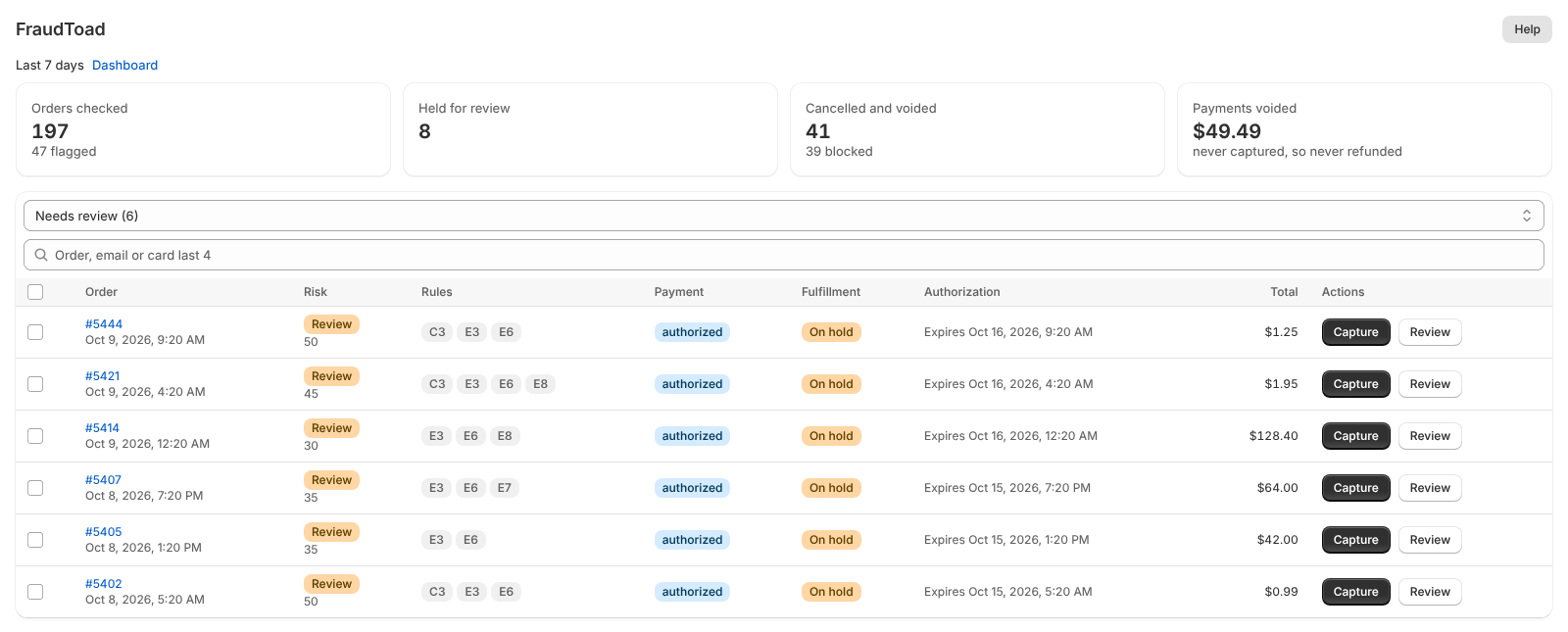
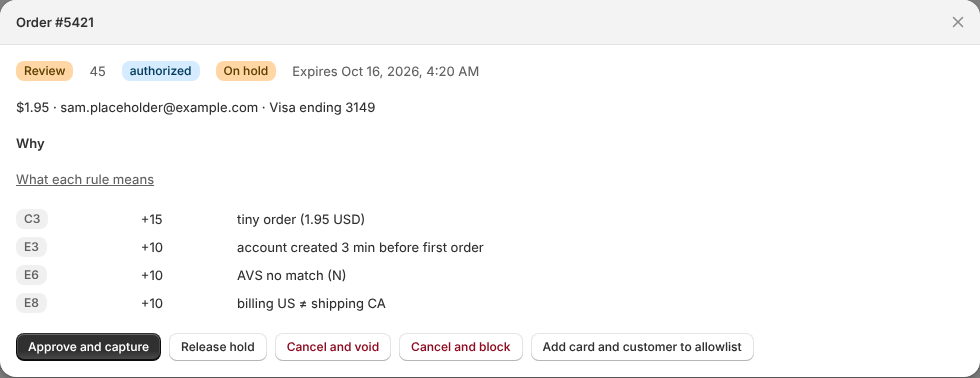
- Starts in shadow mode. It scores and tags orders, and holds, cancels and captures nothing until you switch it on.
- Keeps little, briefly. Order details are deleted after 31 days. Privacy policy.
- Runs inside Shopify. Works through Shopify's own APIs, and you'll be billed by Shopify.
- Made by Seabright Systems. Questions go to support@fraudtoad.com.
What it asks Shopify for
- Orders, read and write: to score each new order, tag it, add a risk note, capture clean orders and cancel and void card tests. It reads only your last 60 days, never your full order history.
- Customers, read only: to see how new an account is and whether it's a repeat customer. It never changes your customers.
- Fulfillment orders, read and write: to put a held order on hold so it isn't shipped before you review it.
- Checkout validation and payment customization: only for the optional checkout lock and card hiding, and only if you turn them on.
What it does
Spots the burst
Rules look across orders, not just at the one in front of them: one card on several accounts, many cards from one IP or bank, one browser behind several shoppers, throwaway emails and brand-new accounts. A store-wide surge of tiny orders turns on attack mode until it's over, and sale mode keeps a rush of real first orders from looking like one. The rules.
Decides safely
Try it in shadow mode, or on your last 60 days of orders, before it touches anything. Choose how far it may go on its own: hold only, cancel and void, or block too. Repeat customers are allowlisted automatically, and an allowlisted order is never cancelled. Getting started.
Sweeps up the rest
When it blocks an order, it re-checks every open order sharing its card, IP, email or customer and voids the ones still uncaptured. You get an email when it acts and when an attack starts, and a dashboard of what it has caught. Blocklist and allowlist.
Every rule, with what it catches and which real customers it can catch by mistake: read the rules.
Pricing
Every plan includes
- Every order scored
- Card tests cancelled and voided before capture, or just flagged while you try it in shadow mode
- Earlier orders in a burst swept up and voided
- Review queue, blocklist and allowlist
- Test on your last 60 days of orders
- Dashboard and email alerts
Launch pricing, by monthly orders
- Free up to 200 orders
- $5/month up to 2,000 orders
- $15/month up to 10,000 orders
- $29/month unlimited
Orders FraudToad cancels or voids don't count. Going over never switches protection off. Billed through Shopify.

What it isn't
FraudToad catches fraud that shows up as a pattern across orders: one card used on a run of new customer accounts, whether to farm first-order discounts or referral credit or to test the card, and bursts of small orders from many cards behind one IP, bank or browser. It won't catch a single carefully placed order with a stolen card, which looks like a real customer; Shopify's own risk analysis is the main signal for those. It isn't a chargeback tool either; it stops what it can before a sale settles, and works alongside one for what gets through. What it can and can't do.